Cheese and Potatoes (Swiss Raclette Château de Villa)
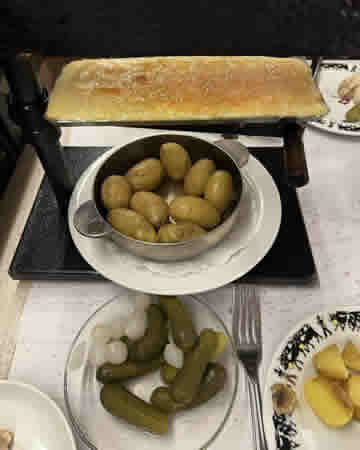 Raclette is a national dish that shares its name with a slightly nutty Swiss cheese made from cow's milk, an appliance for preparing the dish and a full dining experience. Extremely popular in the ski region Valais and other parts of the Swiss Alps, where it also originated, raclette was invented by the Swiss mountain shepherds who used to gather around a fire while roasting potatoes.
As they left some cheese near the fire, it started to melt so they scraped bits of it on the potatoes and raclette was born. The dish takes its name from the French word racler, meaning to scrape. As few people have a fireplace these days, modern appliances such as raclette melter and raclette grill are used instead.
The scraped cheese is usually accompanied by roasted or cooked potatoes with their skin still on, vegetables, cold cuts, pickles, onions and bread. There is also a variety of raclette where the mixture of cheese and other ingredients is scraped onto an opened baked potato.
A perfect dish to share with others during cold, winter nights, raclette is best paired with light white wines or traditional kirsch liqueurs.
The raclette dish is traditionally prepared by heating the raclette cheese either in front of a fire or by a special machine, then scraping off the melted layer onto diners' plates. It's commonly served with boiled potatoes, pickled onions, cornichons (small pickled gherkins) and sometimes dried meats like prosciutto or ham, allowing the melted cheese to be the star of the meal. Nowadays, raclette parties have become popular, where small tabletop grills are used to melt slices of raclette cheese individually. These grills also have a griddle top where guests can cook meats and vegetables to accompany the cheese. This social dining experience emphasizes communal eating and allows guests to customize their plates with various accompaniments to the rich, melted cheese.
The following is the authentic preparation of the raclette using a raclette oven. Accompany the melted cheese with boiled potatoes, pickles and pearl onions. The recipe is courtesy of the Raclette du Valais AOP organization, which is dedicated to protecting, representing and promoting the brand and everyone involved in the process of making the said cheese.
½ wheel Raclette du Valais AOP (~ 2. 4-2. 5 kg/5. 3-5. 5 lbs)
3.5 lbs small potatoes, boiled (1. 6 kg)
pickles
pearl onions
Position a half wheel of Raclette du Valais AOP beneath a raclette oven, ensuring the cheese is maintained at a minimum distance of 6 cm from the heat source.
As soon as the surface of the cheese begins to melt, use a knife and gently scrape the softened layer onto a pre-warmed plate. Angle the cheese slightly downwards towards the plate for easier scraping.
Makes 8 servings.
Cook’s Notes:
- Cheese: Raclette du Valais AOP is the authentic choice, but any semi-hard alpine cheese will also do, such as Gruyère, Emmental and Appenzeller. Young Gouda is an acceptable alternative as well.
- Potatoes: Go for waxy potatoes that will not fall apart when cooking. Ideally, they should be smallish and the skin should not be removed.
- Raclette Oven: From the 1950s onwards, raclette ovens have come to replace the traditional way of doing things: melting the cheese over an open fire. The cheese is placed onto a stand and a heat source from above melts the cheese. Gas ones are said to do a better job than electric ones. Depending on how well grilled you'd like your cheese to be, you can play with the distance between the cheese and the heat source.
- Traditionally, semi-wheels are heated by an open fire, which melts the cheese, grills it and gives it a smokey aroma. Once melted, it needs to be scraped off in one fell swoop with the blunt side of the knife.