Ricotta Cheese
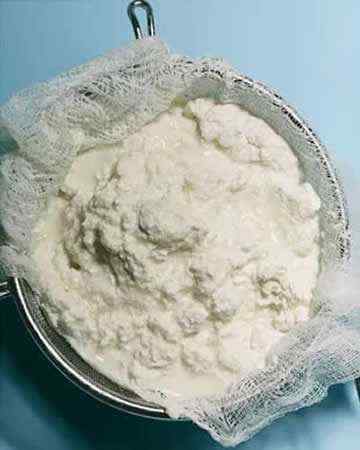 Forget "love": All you need is milk, acid, and salt.
To make about 1 pound, pour 3 quarts whole milk (avoid ultra-pasteurized), ¼ cup white vinegar, and ½ tsp. kosher salt into a large, heavy-bottomed pot over medium heat.
You can subtly change the flavour by choosing different acids: Lemon juice will give it a hint of lemon, while plain white vinegar won't alter the flavour too much. I highly recommend experimenting with different acids - my partner has gotten really into making his own vinegar, and his pumpkin-beet vinegar made for a really interesting ricotta.
Bring the mixture to the absolute barest simmer you can, adjusting the heat as necessary - the mixture should be steaming, but not bubbling. If you have a thermometer, 180-185°F is the sweet spot but 10° in either direction will still net you some tasty cheese.
Once you reach that temperature range, maintain it for about 25 minutes without stirring - we want big fluffy curds, and stirring will break those up. You'll notice the milk start to separate pretty early and curds will start forming throughout the heating process.
Remove from heat, and use a slotted spoon to scoop the curds into a colander double-lined with cheesecloth. Resist the temptation to dump the curds and whey from the pot to the strainer-doing this will clog the cheesecloth and drastically increase the time it takes to strain. Different draining times will result in different textures and moisture levels - I find that letting the ricotta sit in the lined colander for about 30 minutes is right for most applications, i.e. pizza topping, lasagna/manicotti/ravioli filling. If you, like me, just want to eat it by the spoonful or spread onto toast, 5-10 minutes is plenty. Once you've harvested your curds, don't toss that whey down the sink. Use it in smoothies, a replacement for water in bread recipes, or even to make stock or boil grains.
Try your fresh ricotta in salad, incorporated into ricotta gnocchi, or spread on slices of toasted baguette with a little lemon zest, olive oil, and freshly cracked black pepper. Whatever you plan on using your fresh ricotta for, plan on making more than you need - that first "quality control" taste test never stops at just one spoonful.
7 cups whole milk
1 cup heavy cream
3 tsp. kosher salt
5 Tbsp. distilled white vinegar or 3 Tbsp. lemon juice, freshly squeezed
Line a colander with 4 layers of cheesecloth; set in the sink.
Heat the milk and the cream on a heavy bottomed pot/pan until the cream reaches 200°F. Stirring as the milk heats up and make sure it doesn't come to a boil.
Once milk registers 200°F remove from heat and stir in the salt and vinegar or lemon juice. Stir gently for a few seconds and try to create a gently whirling effect to mix the salt and vinegar. This will cause the milk to break into curds. Let the swirling mixture sit at room temp for 10-15 minutes.
Using a finely slotted spoon or skimmer, scoop curds from pan and transfer to cheesecloth-lined colander. Let drain 1 minute (curds will still be a little wet). All of the trapped curds in the cloth is the ricotta cheese. Let the cheese hang in the cloth until the desired moisture level is reached. More time draining the drier the cheese. The leftover is milk whey which can be used for other projects and dishes.
Cover and chill until cold, about 3 hours. Make-Ahead: Can be made 2 days ahead. Keep chilled.
Makes 1 quart.