Almond Milk
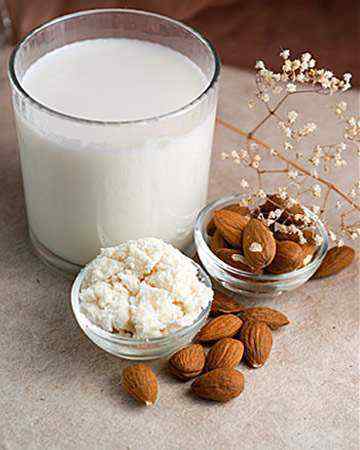 Almond milk is a plant-based milk alternative made from almonds and water, often consumed by those who are lactose-intolerant or follow a vegan diet. It has a mild, nutty flavour and a thinner, watery texture compared to cow's milk. Almond milk is naturally dairy-free and often fortified with vitamins and minerals.
Production: Almond milk is made by blending almonds with water and then straining the mixture to remove the solids. Commercial almond milk often includes additional ingredients like thickeners, sweeteners and flavourings. It can also be made at home by soaking, blending and straining almonds.
Nutritional Value: Unsweetened almond milk is low in calories and carbohydrates compared to cow's milk. It's a good source of vitamin E and can be fortified with calcium and vitamin D. However, it's lower in protein and some other nutrients found in dairy milk.
Health Considerations: Almond milk is naturally lactose-free, making it a good option for those with lactose intolerance. It can be a suitable alternative for vegans and those avoiding dairy. It's important to check the label for added sugars and choose unsweetened varieties for a healthier option. Those with tree nut allergies should avoid almond milk.
1 cup raw almonds
2 cups water, plus more for soaking
sweeteners such as, pure honey, Erythritol, Monk Fruit, agave syrup, or pure maple syrup (optional)
Soak the almonds overnight or up to 2 days. Place the almonds in a bowl and cover with about an inch of water. They will plump as they absorb water. Let stand on the counter, covered with a cloth, overnight, or refrigerate for up to 2 days. The longer the almonds soak, the creamier the almond milk.
Drain and rinse the almonds. Drain the almonds from their soaking water and rinse them thoroughly under cool running water. At this point, the almonds should feel a little squishy if you pinch them. (It's best to discard the soaking water because it contains phytic acid, which inhibits the body's ability to absorb nutrients.)
Combine the almonds and water in a blender or food processor. Place the almonds in the blender or food processor fitted with the blade attachment and cover with 2 cups of water.
Blend at the highest speed for 2 minutes. Pulse the blender a few times to break up the almonds, then blend continuously for 2 minutes. The almonds should be broken down into a very fine meal and the water should be white and opaque. (If using a food processor, process for 4 minutes total, pausing to scrape down the sides halfway through.)
Strain the almonds. Line a fine-mesh strainer with either an opened nut milk bag or cheesecloth, and place over a measuring cup. Pour the almond mixture into the strainer.
Press all the almond milk from the almond meal. Gather the nut bag or cheesecloth around the almond mixture and twist close. Squeeze and press with clean hands to extract as much almond milk as possible. You should get about 2 cups.
Sweeten to taste. Taste the almond milk and if a sweeter drink is desired, add sweetener to taste.
Makes about 2 cups.
Cook's Notes:
- Using the leftover almond meal: The leftover almond meal can be added to oatmeal, smoothies, and muffins as it is. You can also spread it out on a baking sheet and bake it in a low oven until completely dry (2-3 hours). Dry almond meal can be kept frozen for several months and used in baked goods.
- Storage: Store the almond milk in sealed containers in the fridge for up to 2 days.
Nutritional Information:
Per serving: Calories 207 | Fat 17.8 g | Saturated 1.4 g | Carbs 7.7 g | Fiber 4.5 g | Sugars 1.6 g | Protein 7.6 g | Sodium 5.1 mg