Clotted Cream (English)
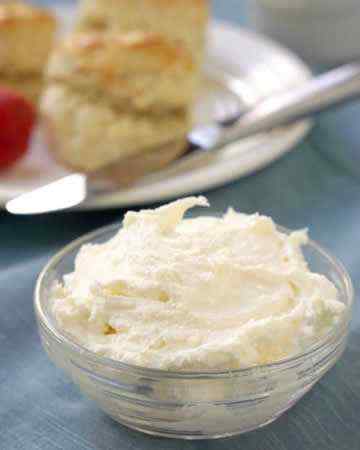 Clotted Cream is deliciously creamy and the essential companion to a batch of British scones. Clotted cream is a silky, yellow cream with a distinctive crust on the surface. It is made by heating unpasteurized cow's milk which then is left in a shallow pan for many hours which causes the cream to rise to the surface and 'clot'. Clotted Cream originates in Devon and Cornwall in the South western corner of England but is now also successfully made in Yorkshire. Sometimes you may hear "clotted cream" called "Devonshire cream" or "Cornish cream". It really all depends on region you are in.
2 cups heavy cream (not ultra-pasteurized)
Preheat your oven to 170-180°F.
Day 1:
Pour the cream into a shallow casserole dish or glass baking dish. (The cream should only come up the sides about 1-2 inches. The key here is to have a lot of surface area.)
Place the cream in the oven for 12 hours, uncovered. (This works great overnight.)
Day 2:
After heating for 12 hours, the cream will develop a skin. Carefully remove the dish from the oven and let it cool to room temperature. Once cool, cover the dish and refrigerate it for 8 hours (or overnight again).
Day 3:
After chilled, gently skim the thick layer of clotted cream from the surface, leaving the thinner liquid behind. (It will feel like you’re pulling a layer of slightly softened ice cream from the top of a layer of milk. The skin in fine, it will soften as it is mixed into the cream.)
Gently stir the skimmed clotted cream to create a smooth texture. (If your cream is too thick for your liking, you can always stir a little bit of the thin liquid back into your cream, until it reaches your desired consistency.)
Store the cream in the refrigerator for up to a week.
Makes 1 cup.
Cook's Notes: The leftover liquid can be used like milk. It’s great for baking.
Oven Note #1: Some ovens have a safety feature that shuts them off after extended periods of time. If this is your oven, you may want to do the clotting step during the day, when you can make sure your oven stays on and at a low temperature.
Oven Note #2: We have a lot of readers who are discovering as they try this recipe that their oven runs hot. After 12 hours in the oven, their cream has developed a dark brown skin. The skin on your cream should only be a pale tan if it starts to darken. If you think your oven may run hot, check your cream after 8 hours and again after 10 hours to see if the top is darkening. If it is, you may need to cycle your oven between off and on to keep a temperature that is not too hot for the cream. (As a side note, the darkened top on the cream does not mean it is ruined. It simply means your finished cream will have a bit of a deeper flavour, and it will most likely have some flecks of brown and not be a pure creamy white.)