Coffee Cake (Armenian Gata)
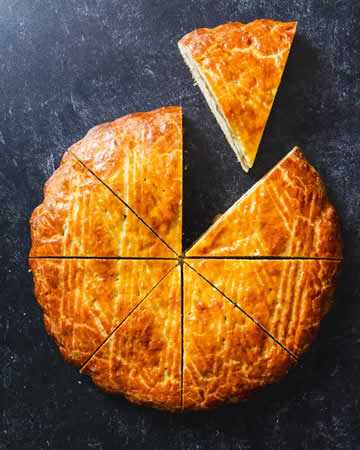 The Brits have scones, the Chinese have youtiao, and the Armenians have gata, a sweet, egg-rich bread that sings alongside tea or a cup of surj, wickedly dark Armenian coffee. The magic of gata lies in its gooey center, a melt-in-your-mouth "custard" of flour, butter, sugar, and (sometimes) walnuts that's encased in a brioche-like dough. The pastry varies widely in shape and ingredients depending on the region, reason enough to sample it as often and in as many places as possible.
At its most basic, a gata - also known as "kata", "gatah", or "katah", depending upon who's doing the transliteration - is a lightly sweetened, buttery Armenian cake, bread or pastry meant to be served as part of a mezze (appetizer) spread, coffee, tea or as a dessert.
Some gata resemble croissants, made from an enriched bread dough rolled into paper-thin, table-wide sheets using an "okhlavoo" (a wooden dowel dedicated to dough work), smeared with butter, rolled up like a carpet and cut into spirals that bake up layered and crisp. Others are sweeter and decidedly more cake-like, whether they're made with a yeast- or baking soda/acidic dairy-leavened dough (baking powder was, until very recently, unknown in Armenia, so most chemically-leavened baked goods are made using a combination of baking soda and an acidic dairy like yogurt or sour cream). This latter style is usually formed into a flattened disc and filled with a single layer of a butter, flour, sugar, vanilla, and (sometimes) chopped nut paste known as khoritz, a mixture that's essentially the Armenian equivalent of streusel. These simpler gata are often dressed up with decorative strips of dough or by scoring patterns onto the top before baking.
Dough:
10 oz (2 cups + 2 Tbsp.) all-purpose flour, unbleached (285 g)
1¼ tsp. instant yeast (5 g)
1/8 tsp. baking soda
2 tsp. Diamond Crystal salt; for table salt use half as much by volume or same weight (6 g)
5 oz (10 Tbsp.) salted butter, softened (140 g)
2 oz (about ¼ cup) sugar (60 g)
5 oz (about 2/3 cup) plain Greek yogurt (140 g)
1 large egg, lightly beaten (55 g)
Filling:
3 oz walnuts, lightly toasted and coarsely chopped (85 g)
2 ½ oz (about ½ cup) all-purpose flour, unbleached (70 g)
2 oz (about ¼ cup) sugar (60 g)
¼ tsp. Diamond Crystal salt; for table salt use half as much by volume or same weight
2 oz (4 Tbsp.) salted butter, melted (60 g)
2 tsp. pure vanilla extract (10 mL)
Assembly:
1 large egg, lightly beaten with a pinch of kosher or sea salt
For the Dough:
In a medium bowl, whisk together flour, yeast, baking soda, and kosher or sea salt. In a large bowl, using a stiff rubber spatula, vigorously stir butter and sugar together to form a uniform paste. Add flour mixture to butter mixture; wipe out bowl that had flour mixture, lightly grease with cooking spray or butter, and set aside. Using spatula followed by hands, mix flour and butter mixtures together until even, cornmeal-like mixture forms, 1 to 2 minutes.
Add yogurt and egg, and, using spatula followed by hands, stir until stiff, even dough forms, about 2 minutes. Transfer dough to the prepared lightly greased medium bowl and cover tightly. Let sit at room temperature for 30 minutes, then transfer to refrigerator and chill for at least 4 hours, and up to 16 hours.
For the Filling:
In a medium bowl, stir together walnuts, flour, sugar, and kosher or sea salt. Add butter and pure vanilla extract and, using a rubber spatula, stir until clumpy paste forms and no dry flour remains, about 30 seconds. Cover and store at room temperature until ready to assemble.
To Finish and Bake:
Adjust oven rack to middle position and preheat oven to 375°F (190°C).
Transfer dough to clean, lightly-floured surface, and dust top of dough lightly with flour. Using hands, gently press dough into even 6" circle, adding flour to both sides of dough as needed to prevent sticking, while pinching closed any major cracks in dough that form. Using a rolling pin, roll dough into a 12" circle, about ¼" thick.
Place filling in center of dough and, using clean hands and rubber spatula, spread into an even 5" round disc, leaving a 3½" border of dough on all sides. Starting at one edge, using your hands, fold and pleat dough over filling toward center, working your way around disc. Pinch and press pleats together to fully enclose filling. Press top of dough gently to form an even 6" round. Invert so seam side is facing down and, using a rolling pin, gently roll into an even 9" round. Carefully transfer to a rimmed baking sheet lined with parchment or a silicone baking mat.
Pinch dough around the edge of the gata between the index finger of one hand and thumb and index finger of the other hand to form decorative points, spaced about 1" apart. Brush top and sides of gata evenly with egg wash. Using a fork, drag flat underside of fork across top of gata to form grooved lines in a crisscross pattern, spaced about 1" apart. Using a toothpick, poke 8-10 evenly spaced holes in top of dough, stopping when you reach the filling. Bake until evenly golden brown, 28-35 minutes, rotating baking sheet after 20 minutes.
Transfer baking sheet to wire rack and let gata cool for at least 20 minutes. Slice into wedges, and serve.
Makes 8 servings.
Cook's Notes:
- Walnuts are traditional here, though other nuts such as pecans, pistachios, or almonds would make excellent substitutes.
- The dough will likely crack along the edges when being rolled and pressed out; just pinch the dough as needed to smooth it out.
- When decorating the top of gata, dip the tines of your fork regularly in flour to prevent dragging.
- The edge pleats and top decorations will soften and smooth out as the gata bakes, so be sure to make them as distinct and sharp as possible.
Make-Ahead and Storage:
The gata filling can be refrigerated for up to 3 days, if desired. Allow to come to room temperature before using, about 30 minutes. Gata is best served on the day it's baked, though it can be covered and stored at room temperature for up to 24 hours. Reheat in a 250°F (120°C) oven for 15 minutes before serving.