Pasta c'Anciova e Muddica Atturrata (Sicilian Anchovies, Pinenuts, Raisins and Pangrattato)
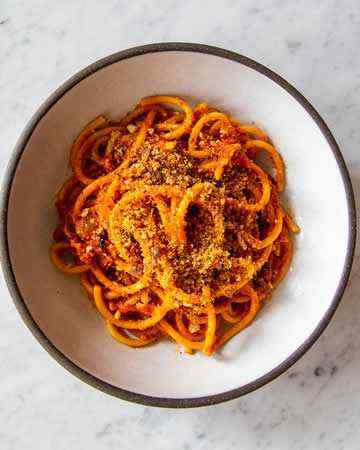 A deeply satisfying but simple Sicilian pasta, rich with tomato, anchovies, and toasted breadcrumbs. The sea, the sun, and the interplay of salty, sweet, and sour. This is the tongue-twisting list of things that come to mind when I think of Sicily and its cuisine. And all of these qualities are at play in a dish I was recently introduced to called pasta c'anciuova e muddica atturrata, which hails from Palermo. This no frills title translates from dialect to "pasta with anchovies and toasted breadcrumbs." The name might turn off anchovy skeptics who prefer to have the presence of delicious salty fish hidden behind names of back-stabbed Roman emperors (or maybe they've unknowingly made a wildly popular, more "approachable" version of this Sicilian pasta already, and refer to it by its viral internet title that cleverly plays up the allium elements of the dish rather than the 'chovies). These people are missing out. This is an example of "cucina povera" (the peasant cooking or the cooking of the poor people). Anchovy has always been part of the Sicilian diet; the island is located in the middle of the Mediterranean Sea and people have been catching and preserving anchovy for centuries. Breadcrumbs, from stale bread, were used instead of grated cheese because only the rich could afford to use cheese (pecorino or ricotta, because, in the past, that was the type of cheese you could find in Sicily). There are different versions of this recipe, but in general terms, people from the west of the island (i.e. Palermo) like to add tomato to their sauce, while people from the east (i.e. Catania) do not use tomato. The Spanish introduced the tomato in Europe around the 16th century and, initially, it was used only as ornamental plant. Then, in the 17th century, tomato started to appear in various recipes. It is likely that "Pasta c'anciova e muddica" dates back before the introduction of the tomato to the island, hence the oldest recipe is the east version. Here, I am presenting the east version of the recipe and I hope you will all enjoy it; it is a great dish if you love anchovy.
Pasta:
14 oz long pasta, such as; trenette, linguine, bucatini or spaghetti (400 g)
3 Tbsp. kosher salt
Pangrattato:
8 oz bread, cut into ¾-1" pieces (225 g)
1 Tbsp. extra-virgin olive oil (15 mL)
kosher salt
Sauce:
3 Tbsp. extra-virgin olive oil (45 mL)
½ small yellow onion, thinly sliced (about 3.5 oz; 100 g)
2 cloves garlic, thinly sliced (10 g)
10-12 anchovy fillets (40-50 g)
3 Tbsp. (50 g) tomato estratto or 1/4 cup (65 g) tomato paste (see notes)
1 Tbsp. golden raisins (15 g)
1 Tbsp. pinenuts (10 g)
½ cup toasted breadcrumbs, divided (60 g)
Garnish:
remaining breadcrumbs
For the Pangrattato:
If using fresh or lightly stale bread, adjust oven rack to middle position, and preheat oven to 325°F (165°C). (If using fully stale and dried bread, skip baking step.) Arrange bread in single layer on rimmed baking sheet, and bake until completely dried, 20-30 minutes.
Remove from oven, and allow to cool to room temperature, about 5 minutes. Transfer bread to food processor bowl (set aside but don't clean rimmed baking sheet), and pulse until reduced to small crumbs, taking care not to over-process into a fine powder, 8-10 pulses.
Combine breadcrumbs and 1 Tbsp. (15 mL) oil in a large skillet, and cook over medium-low heat, stirring and tossing occasionally, until crisp and golden brown, 8-10 minutes. Season lightly with salt.
Transfer toasted breadcrumbs to reserved rimmed baking sheet, spread into an even layer, and set aside to cool to room temperature. Once cool, set aside ½ cup (60 g) toasted breadcrumbs for the pasta, and transfer remaining crumbs to an airtight container for future use; the extra breadcrumbs can be stored at room temperature for up to 2 weeks.
For the Pasta:
Bring a large pot of water to a boil over high heat, and season very lightly with salt; use a ratio of 1 Tbsp. (12 g) of Diamond Crystal kosher salt per 1 gallon (4 L) of water.
For the Sauce:
In a large skillet, heat 3 Tbsp. (45 mL) oil over medium heat until shimmering. Add onion and garlic and cook, stirring frequently, until softened but not browned, 5-7 minutes. Add anchovies and cook, stirring and breaking up anchovies occasionally with a wooden spoon or rubber spatula, until anchovies have dissolved, about 4 minutes. Add tomato estratto or paste, stir to combine with allium-anchovy mixture, and continue to cook until mixture turns dark brick red and is very dry, 2-4 minutes longer.
Transfer 1 cup (240 mL) boiling water from pot to skillet to loosen tomato-anchovy mixture, and stir until it becomes homogenous and saucy. Reduce heat on skillet to lowest possible setting, to just keep sauce warm; if your burner can only be reduced to a simmer, then turn heat off entirely.
Cook pasta in the pot of boiling water until just softened on the exterior, but well shy of al dente, and still uncooked in the center (2-3 minutes less than the package directs). Using tongs, transfer pasta to sauce, along with ½ cup (120 mL) pasta cooking water. Alternatively, drain pasta using a colander or fine-mesh strainer, making sure to reserve at least 1 cup (240 mL) pasta cooking water.
Increase heat to high and cook, stirring and tossing rapidly, until pasta is al dente and sauce coats noodles and just pools around the edges of the pan, about 2 minutes, adding more pasta cooking water in ¼ cup (60 mL) increments as needed. Add raisins and pine nuts (if using), half of the breadcrumbs (¼ cup; 30 g), and toss to combine. Pasta should be well-coated but not swimming in sauce (this dish is meant to have a slightly drier consistency than typical sauced pastas). Adjust sauce consistency as needed with more pasta water if it seems too dry, or an additional small handful of breadcrumbs if it seems too loose.
Remove from heat, divide pasta between individual serving bowls, sprinkle with remaining breadcrumbs, and serve right away.
Makes 4 servings.
Cook's Notes:
- Muddica atturrata (toasted breadcrumbs) are traditionally made with pangrattato breadcrumbs made by processing stale bread. This recipe is written to make extra toasted breadcrumbs from fresh or stale bread (we used sourdough bâtard during recipe testing, but most types of white bread will work fine) because if you are taking the time to make your own breadcrumbs, you might as well make a big batch so you have some ready to go in your pantry for future use. If you don't want to make your own breadcrumbs, you can substitute ½ cup (35 g) panko breadcrumbs, and toast them with oil as written in the recipe.
- Both salt-packed and oil-packed anchovies will work for this recipe. If using firmer salt-packed anchovies, cut them into ½" pieces before cooking, as this will help them break down more quickly. If using tomato estratto, use 10 fillets (40 g). If using tomato paste, use 12 fillets (50 g), to compensate for the increased sweetness and diminished savoriness of the tomato product.
- Sicilian tomato estratto is made by sun-drying milled tomatoes on wooden tables or terra cotta trays for about 1 week to produce a super-concentrated paste that is sometimes homogenized with a small amount of extra-virgin olive oil. While similar in appearance to tomato paste, estratto has a much more intense savoury flavour, and a drier texture. It is a key component to this dish and worth seeking out (purchase it online here), but it is an expensive specialty product. As a result, I have provided instructions for making this recipe with more affordable tomato paste. Tomato paste is much sweeter and has a more forward, bright, fresh tomato flavour. For this reason, if using tomato paste, the amount of anchovies should be increased to 12 fillets, and the golden raisins should be left out. The dish won't have quite the same savoury punch when made with regular tomato paste, but it will still be very tasty.
- Raisins and pine nuts are important ingredients in Sicilian cuisine; they provide pops of sweetness/nuttiness and textural contrast in dishes like pasta con le sarde and caponata, as well as this pasta. That said, if you don't have them on hand, you can certainly do without them in this recipe without worrying about ruining the dish. No need to make a special run to the grocery store for 1 Tbsp. of each.
- Make-Ahead and Storage: The toasted breadcrumbs can be made up to 2 weeks in advance and stored in an airtight container at room temperature. The cooked allium-anchovy-tomato mixture (prior to loosening with cooking water) can be made in advance and refrigerated in an airtight container for up to 7 days, though there is no real need to do that.