Napoleon (French Mille Feuille)
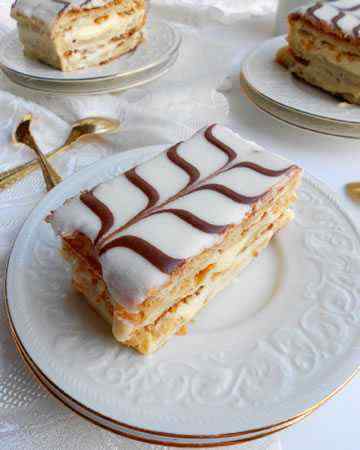 Translating literally as "a thousand leaves", this world-famous French dessert consists of three components: puff pastry, pastry cream or whipped cream, and a glaze or a fondant. The delicate puff pastry is first rolled and trimmed to fit the desired shape, and once baked, both sides of the pastry are lightly dusted with powdered sugar and quickly caramelized under a broiler for extra crunch. The finished pastry is then cut into three strips, which are layered with either pastry cream or whipped cream, and sometimes fruit may be added as well. The top of the assembled cake can be sprinkled with powdered sugar or glazed with a signature icing consisting of alternating white and brown stripes.
Even though many elements of this dessert have been known since the 16th century, it was not until 1651 that La Varenne published the first recipe for what he called gâteau de mille-feuilles. At the time, mille-feuilles were layered with marmalade and jam, but it was the changes made by Marie-Antoine Carême that vastly improved and transformed mille feuille into the treat we know and love today.
Pastry:
puff pastry (200 g)
powdered sugar
Pastry Cream:
milk (600 mL)
½ pinch kosher salt
½ vanilla bean
3 eggs
cornstarch (60 g)
granulated sugar (150 g)
100 glucose or 130 g more granulated sugar
Glaze:
fondant (300 g)
dark chocolate, chopped (50 g)
Preheat oven to 390°F (200°C/180°C fan, Gas Mark 6).
To prepare the pastry, you will need a rectangular 30x40 cm baking tray. Roll out the puff pastry to fit the tray, transfer it to the tray, and then prick the pastry with a fork.
Bake for 15 minutes, then remove from the oven and cover with parchment paper. Now, place the same sized baking tray over the parchment-covered pastry to prevent the pastry from rising too much, but be careful that the tray is not too heavy, then bake for another 30 minutes.
Once the 30 minutes have passed, take out of the oven, set the oven temperature to 260°C and turn on the grill mode. Now, remove the cover tray and parchment paper, and sprinkle the pastry with powdered sugar, then bake for 5 minutes, but be careful not to burn the pastry. Immediately after you take the puff pastry out of the oven, cut it in three equally sized bands (smaller side of the big rectangle, once cut, becomes the long side of the bands).
To make the pastry cream, in a saucepan heat milk with one-half of the sugar and a vanilla bean. Then, in a separate bowl, whisk eggs, cornstarch, and sugar and once the milk has boiled, pour it in three times over the egg mixture - that way the eggs will not curdle. Place the entire mixture into a saucepan and continue cooking on medium heat while continuously whisking.
Once boiling, leave the cream to boil for two minutes, remove it from heat and pour on a pan covered with plastic wrap, then cover the pastry cream with a plastic wrap, and leave to chill.
When both the cream and the pastry bands have cooled, fill a piping bag fitted with a big plain tip with cream, and pipe stripes of cream on the band of pastry (flat side down), and place the second band of pastry to on top and repeat with the cream. Finish by placing the third band of pastry flat side up and let the assembled mille feuille chill.
To make the glaze first melt the chocolate and place it in a parchment paper piping cone. In a bain marie, heat the fondant with half a spoon of water, but make sure you do not overheat it. Ideally, the temperature should only be at around 35-37°C. Pour the runny fondant on top of the mille-feuille and quickly spread it with a spatula. The fondant dries quickly, so make sure you do this fast.
Before the fondant dries completely, with a piping cone quickly draw on it multiple chocolate lines. Using the back tip of a knife, make evenly-spaced perpendicular lines, then halfway between those lines, make marks with a knife, but this time in the opposite direction.
Chill the finished mille-feuille for a couple of hours in the refrigerator or freeze it for 20 to 30 minutes then, using a serrated knife, cut a couple of millimeters from the edges to make them straight.
Once the mille-feuille is cold and firm, cut it into individual portions with a serrated knife.
Makes 10 servings.
Cook's Notes:
- GLAZE: It's the white and brown chevron stripes of the fondant glaze that this dessert is most recognized for, but if you're a beginner, or not in the mood for extra work, you can simply dust your mille feuille with powdered sugar, cocoa, or ground nuts.
- FILLING: Although most commonly filled with pastry cream, there are no rules when it comes to the type and flavour of the filling, and if there are, go ahead and break them. The tried and proven type of filling is whipped cream, or pastry cream, in combination with fruit. Mille feuilles can also by savoury - a popular version is one with a spinach and cheese filling.
- FORM: Beside the rectangle shape you can assemble the mille feuilles as a big cake in the form of a circle, or you can take a different route and completely forget about form. Scatter the filling and decoration on the plate, then top it with shards of crispy pastry.