Pike Dumpling with Lobster Cream Sauce (French Quenelles de Lyon avec sauce Nantua)
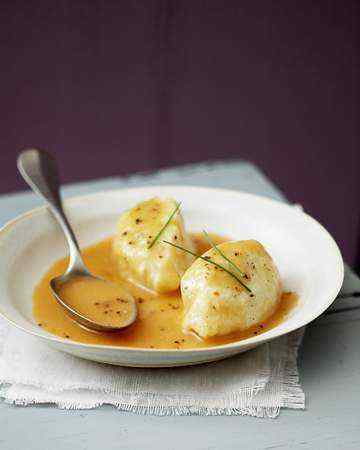 The mouth-watering, refined quenelle de Lyon indeed accounts for the culinary jewels of the Rhone Alpes region. The quenelles de brochet indeed represent the authentic Lyonnais cooking, made out with really local ingredients amongst which pike, usually fished in Rhone Alps streams, and free-range eggs from the neighbouring French region of Bresse renowned for its quality poultry. Freshwater crayfish is another essential element of the quenelle dish since it composes the creamy Nantua sauce traditionally accompanying the pike dumplings.
Quenelle Base:
milk (125 mL)
butter (30 g)
all-purpose flour, unbleached (60 g)
1 egg
Forcemeat:
pike, filleted and skinned (300 g)
heavy cream, well-chilled (500 mL)
2 egg whites
2 tsp. sea salt
pepper
nutmeg, freshly grated
Lobster Sauce:
2 lobster heads or 6 scampi heads
1 medium onion
1 medium carrot
2 cloves garlic, peeled
1 sprig fresh thyme
tomato concentrate (50 g)
cognac (350 mL)
olive oil (250 mL)
white wine (50 mL)
heavy cream (750 mL)
2-3 Tbsp. Noilly Prat vermouth
sea salt
black pepper, freshly ground
Poaching Liquid:
fish stock (1 L)
Prepare the quenelle base first. Cut the butter into large cubes. Pour the milk into a saucepan, add the butter, and bring to a boil. Add the all-purpose flour, unbleached, then continue cooking on low heat and mixing thoroughly for 3-4 minutes. Remove the saucepan from the heat, add the egg and mix well. Set the mixture aside to cool completely.
Then make the fish forcemeat. Rinse the fish under cold running water. Place it on a cutting board and chop it finely, using a large knife. Put the chopped fish into a large bowl and mix in the salt, 1 pinch pepper, and 1 pinch nutmeg. Put the fish forcemeat and quenelle base into a food processor together. Blend for 3-4 minutes. Add the egg whites and blend again. Add ¾ of the cream and keep the rest of the cream chilled. Blend the mixture until the consistency is perfectly smooth. Gently mix in the rest of the cream, using a spatula. Let the mixture rest in the refrigerator for at least 1 hour 30 minutes.
Prepare the sauce. Peel the onion. Peel and wash the carrot. Cut the onion and carrot into large cubes. Heat the olive oil in a large saucepan. Add the seafood heads and crush them with a pestle. Add the onion, carrot, garlic, thyme, and tomato concentrate. Add the Cognac and white wine. Add just enough water to cover. Bring to a boil and simmer to reduce the volume by three qters (at least 30 minutes). Add the cream. Reduce the volume by another qter on low heat. Strain the sauce through a fine sieve or conical strainer, pressing it through with the back of a spoon. Add salt and pepper to taste.
Take the forcemeat out of the refrigerator. Prepare a dish and a small saucepan of boiling water. Dip two spoons in boiling water, scoop up some mixture with one spoon, heaping it up well, then use the other spoon to compact and shape the quenelle. Then use that spoon to remove the quenelle from the first spoon. Transfer the quenelle from one spoon to the other several times to give it an even shape and lay it gently in the dish. Dip the spoons in the boiling water between each quenelle.
Heat the fish stock in a saucepan (do not let it boil), then reduce to low heat. Drop the quenelles gently into the stock and simmer for 8 minutes. Use a skimmer to turn the quenelles over and simmer for another 8 minutes on low heat.
Heat up the sauce in a saucepan. Add the Noilly Prat. Arrange the quenelles on an ovenproof dish, pour the sauce over them, and heat under the grill for 2 minutes just before serving.
The quenelles may be cooked in advance, but should be reheated in simmering fish stock at the last minute. If you are unable to prepare lobster sauce, the quenelles may be served with a white-wine sauce.
Makes 6 servings.
What to drink: A chardonnay.
For dessert: Some bugnes lyonnaises, a sweet treat from Lyon.