Black Bean Stew (Brazilian Feijoada)
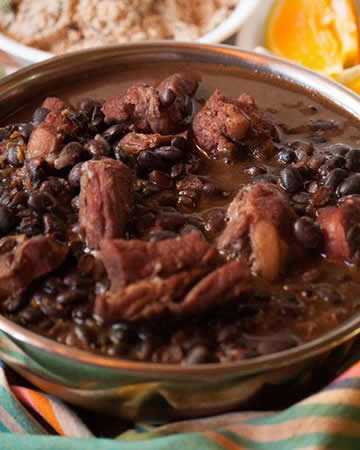 Just like the Sunday roast in the Western world, feijoada is a staple weekend dish in Brazil prepared to feed large families and groups of friends in an economical, yet delicious manner. This black bean stew is brewed slowly with a mélange of salted and smoked beef and pork products, and it is seasoned with sautéed onions, garlic, and bay leaf. Traditionally, feijoada was made with the cheapest cuts of meat such as pork feet, tails, snouts, ears and beef tongue, while smoked beef, bacon, pork ribs, and sausages were introduced later, as the dish developed. As for the preparation, it is a lengthy process which starts a day ahead - the first step is to desalt the salted meat products by soaking them in water, changing it every few hours. If dried black beans are used, they need to be soaked overnight as well. The meat and beans are then cooked together slowly until they become tender, and the surrounding liquid becomes gelatinous and black. Sautéed onions and garlic are stirred in at the very end, and after 10-15 minutes of simmering the feijoada is ready to be served. Quite often, an aperitif called caldinho de feijão is offered before the feijoada itself, and it is basically a bean broth served in shot glasses. The feijoada comes to the table accompanied by cooked rice, sautéed cabbage or kale, fresh orange wedges and farofa, toasted manioc flour enhanced with butter and onions. Finally, the feijoada is washed down with a can of ice cold Brazilian beer, a glass of sugarcane brandy cachaca, or a caipirinha cocktail.
The popular belief is that the feijoada was invented in the early 17th century by African slaves working on Brazilian sugar plantations, who combined meat leftovers with beans and turned them into a satiable stew. However, historical research shows that the feijoada was in fact invented in Northern Portugal during the Middle Ages, and was originally prepared with white beans which are called feijão in Portuguese. After the arrival of colonizers to Southern America, the dish was adapted with the use of local ingredients, techniques and side dishes, and became the feijoada we know today.
7 oz dried beef (200 g)
7 oz salted or smoked pork ribs (200 g)
7 oz salted pork feet (200 g)
3.5 oz salted pork tails (100 g)
3.5 oz salted pork ears (100 g)
5.3 oz smoked or salted pork loin (150 g)
3.5 oz paio sausage (100 g)
3.5 oz Portuguese sausage (100 g)
3.5 oz smoked beef tongue (100 g)
1.75 oz bacon (50 g)
2 lbs black beans (900 g)
2 cups oil (480 mL)
7 oz onion, chopped (200 g)
3.5 oz garlic, chopped (100 g)
6 bay leaves
2 oranges, cut in half
To Serve:
cooked white rice
sautéed cabbage seasoned with olive oil and garlic
manioc farofa
Clean the salted meat thoroughly by removing the excess fat and hairs. Soak in water for 24 hours. Change the water 3-4 times during this period.
Boil the meat for 20 minutes over high heat. Throw away the water the meat has been cooked in.
Place the beans, bay leaves, oranges, dried beef, pork feet, and pork ear in a large pot filled with water. Cook for 30 minutes.
Then, add ox tongue, pork tail, and pork ribs and cook for another 30 minutes.
Finally, add the pork loin, paio sausage, Portuguese sausage, and bacon and cook for 30 more minutes. During cooking, remove and discard any fat that floats on the surface and use a fork to check the degree of softness for each piece of meat. If you estimate a particular piece is already cooked, take it out of the pot and set aside.
Meanwhile, heat the oil in a frying pan and sauté onion and garlic until lightly browned. Remove the orange halves from the cooking pot, and stir in sautéed onion and garlic. Take the meat out of the pot, cut into smaller pieces if necessary, then put back into the pot and simmer for 10-15 minutes over low heat.
Serving Suggestions:
The traditional accompaniments are Brazilian-style rice, collard greens, farofa (toasted manioc meal), hot pepper sauce, and orange wedges, which are thought to help with digestion.
If you'd rather not serve these traditional Brazilian sides, serve white rice with butter, salt, and pepper or seasoned with onions, garlic, cumin and cayenne pepper; fresh green salad with chipotle dressing; and cornbread or corn muffins.
If you're a beer aficionado, serve this hot and spicy dish with a stout or brown or pale ale. If you're a wine drinker, a big red is the thing to choose. Pick from a malbec, tempranillo, zinfandel, syrah or shiraz, or a blend that is heavy on any one of these. All will taste great with this hearty dish.
Makes 6 servings.
Cook's Notes:
MEAT: Originally, feijoada is prepared with salted and/or smoked pork legs, tails, snouts, ears, and beef tongue, which are today typically replaced with bacon, pork ribs, dried beef and various sausages. The meat needs to be cleaned from excess fat and leftover hair before soaking and further preparation.
DESALTING: Salted pieces of meat need to be desalted before cooking. To do that, soak them in plenty of cold water, preferably overnight, and make sure you change the water every couple of hours.
SAUSAGES: Different kinds of sausages can be used for feijoada. The most common are paio and Portuguese sausage - paio is a cured sausage made from pork and beef, while Portuguese sausage is made exclusively from pork and has a strong garlic flavour. Spanish chorizo sausage and blood sausages make a delicious alternative.
BEANS: Both canned and dried black beans can be used to prepare feijoada. If you use dried beans, soak them in water overnight, discard the liquid, and cook them with desalted meat until they all become tender. In the case of canned beans, they should be added at the end. To make feijoada denser, take out some of the cooked beans, purée them with a fork or by using a blender, and return to the pot.
COOKING: The key to a perfect feijoada lies in good timing. The cuts of meat which take longer to cook, such as pork ears, legs, and dried beef are cooked for a longer period of time compared to the more tender parts, such as pork loin, bacon, and sausages, which are added at the last half hour of cooking. Remove the excess fat from the surface using a slotted spoon or a mesh spoon. Also, it is advisable not to add any salt into feijoada, or to do it sparingly, since the meat ingredients are already salty enough.
ORANGE: Other than as a garnish, the oranges can also be added into feijoada, because their acids help in dissolving the excess fat hence making the meat softer. Halved oranges are cooked with meat and beans, and are thrown away before serving.
FAROFA: A mainstay of every Brazilian table, farofa is a very common side dish made by toasting manioc flour in butter for about 10 minutes. Farofa is typically seasoned only with salt, but can also include additional ingredients like onion, garlic, and bacon, to name a few.