Scalloped Potatoes (French Pommes Anna)
 Once located on boulevard des Italiens, Le Café Anglais dominated Paris’s social and culinary scene in the nineteenth century, thanks to its rarefied atmosphere and visionary chef, Adolphe Dugléré, who had trained under Antonin Carême. The restaurant closed on the eve of World War I, but its legacy lives on in literature - in the work of Zola, Flaubert, Maupassant, and Proust - and through the chef’s creations. The most famous is probably Pommes Anna, named in honor of a famous courtesan who frequented the restaurant, Anna Deslions. It is rare to find this dish on the menu at Parisian restaurants nowadays, which is a shame. Pommes Anna is a study in simplicity and sophistication: Thin slices of potatoes are arranged in a spiral pattern, each layer brushed with melted butter and sprinkled with salt, then baked until golden. I gild the lily by using brown butter, which adds a nutty flavor. The dual allure of this potatoes Anna recipe: a buttery, soft potato cake on the inside, with a crisp, golden exterior. So simple that it takes only a few ingredients, pommes Anna makes a rustic side dish of potatoes elegant and refined. Pommes Anna is a classic 19th-century French dish that was created during Napoleon III’s era. The dish was so named after one of the beautiful women in his court. The humble potato is thinly sliced and elegantly layered in a pan. The layers are sprinkled with Swiss cheese, basted in butter and baked to perfection. As they bake, the potatoes are compressed so they hold together when unmolded. The potatoes on the outside become golden brown and crispy, while the ones inside absorb the butter and turn satiny soft. This dish is such a classic in France that a special piece of equipment was invented to make it in, called a cocotte aux pommes Anna. This is a copper pan with a top and bottom half that fits together and lets you turn the dish repeatedly as you cook it, meaning the potato slices turn a beautiful golden brown on both sides. No worries though, you can always use a springform pan.
2½ lbs waxy potatoes
5 Tbsp. butter
sea salt
black pepper, freshly ground
For the Potatoes:
Preheat the oven to 425°F (220°C/200°C fan, Gas Mark 7).
Using a sharp knife or mandoline, slice the potatoes 1/8" (4 mm) thick. (Do not rinse or soak the slices; the starch is what binds the layers.)
In a small saucepan, melt the butter over medium heat and cook, swirling the pan, to get it to the brown butter stage: First, the butter will boil in large bubbles. Soon, the bubbles will get smaller, the pitch of the boil will get higher, and the butter will turn light brown and smell nutty. At this point take off the heat immediately and pour into a bowl. (If you overcook the butter, the solids will burn and form black, acrid-tasting flakes. Throw it out and start again; it’s happened to the best of us.)
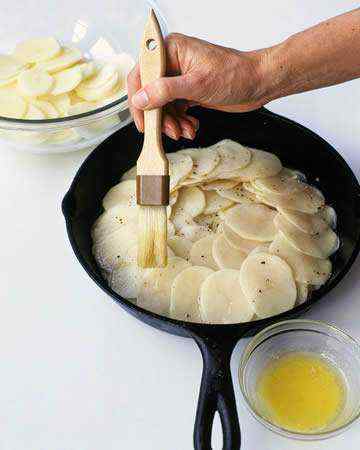
Grease the bottom of a shallow 10" ovenproof cast-iron pan with some of the brown butter. Cover the bottom of the pan with one-third of the potato slices, arranging them in a slightly overlapping, circular pattern. Brush with one-third of the remaining butter and sprinkle with ½ teaspoon of the salt. Make two more layers using the remaining potatoes, butter, and salt. Set over medium heat and cook, without disturbing, to initiate browning on the bottom, 10 minutes. Cover loosely with foil, transfer to the oven, and bake for 30 minutes. Remove the foil and bake until the potatoes are cooked through (a knife should pierce through easily) and the top is browned and crusty, 20-30 minutes. Let rest for 10 minutes on the counter.
Run a spatula around the edges and underneath to loosen and flip carefully onto a serving plate so the golden bottom faces up. If any of the potatoes are stuck to the bottom of the pan, scrape them off and return them to where they belong. (If you don’t feel up for the flipping, it is fine to serve the potatoes directly from the pan.) Slice into wedges and serve.
Makes 4-6 side servings.
Cook's Notes: Brushing each layer with butter and seasoning with salt and pepper creates a delicious buttery flavour throughout.
Variation: Alternate potato layers with turnip slices making sure that they are the same size.