Baked Potato (English Jacket Potato)
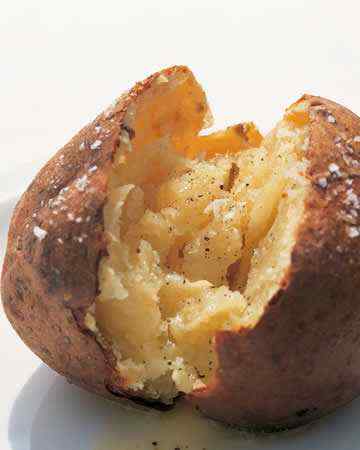
If you jump across the pond to England, you'll find baked potatoes just about everywhere, but you might not recognize them at first. That's because they're called jacket potatoes (which, is just about the cutest name there could be). The difference isn't just the name, however. The Brits take great care when it comes to their potatoes - and the results really are much crispier on the outside and fluffier on the inside than the typical North American variety. The clue to the perfect jacket potato lies in the name - any old baked potato can have a delectably fluffy interior, but it takes real skill to achieve that wonderfully crunchy skin. It's not something which can be rushed, which is presumably why most high-street potatoes are such damp squibs: this is a treat best cooked at home.
Making baked potatoes isn't difficult, but here are the tips that made the most difference:
Slice them first. Like most Americans, I typically poke holes all over the potatoes before baking them to ensure they don't explode in the oven. But try slicing a cross shape about ¼" thick into each potato. This helps them release some steam, makes the interior fluffier, and also makes them easier to slice into when they're piping hot.
Bake them for longer than you think. Many recipes (ours included) recommend baking potatoes for an hour at 425°F. Instead, try baking potatoes at 400°F for closer to two hours. The potatoes won't burn at this temperature and the long bake means the skin will be so crisp that it's practically cracker-like. Yum.
Return them to the oven. After the two hours are up, remove the potatoes and carefully cut deeper into the slices you made initially. Then put the potatoes back in the oven for 10 more minutes. This helps to dry out the flesh further and makes it extra fluffy.
When you take those piping hot spuds out of the oven, push open that crispy, crackly skin, drop a little butter, and sprinkle plenty of salt (I like Maldon flaky sea salt) and freshly ground black pepper into the lightest, fluffiest baked potato you've ever made.
Plain and Simple:
There is at least no debate about the best kind of potato for baking - that billowing, cloud-like flesh is the exclusive preserve of the floury varieties, such as Maris Piper or King Edward. Some people, including Nell McAndrew, reckon that's the only thing you need for a baked potato - so I give it a whirl. My floury potato goes into a 190C oven for 50 minutes, until it gives slightly when I press it with my asbestos fingers. It's a bit of a disappointment though; although the inside is fluffy enough, so is the skin, which reminds me powerfully of a Russet apple. That's the last cooking advice I'm taking from a glamour model.
Salt and Water:
Keeps things nice and simple. We suggest washing the potato (which might be a practical necessity, depending on where you buy yours) and then dusting them with sea salt while they're still wet, which gives a 'crisp and savoury skin'. It's got a definite crunch to it, and, ready seasoned, only requires a knob of butter to become a meal in its own right. I experiment with coarse salt too, and find I prefer the crunch, although the coating is not quite as even.
Oil and Salt:
Sometimes, it's tempting to think that everything is improved with a bit of fat. Well, I find it tempting, anyway. And, when it comes to food at least, it's usually true. So the BBC's perfect baked potato, which is massaged with oil and rubbed with salt, in the manner of a Turkish bath, seemed a sure winner.
I use British rapeseed oil, as olive seemed contrary to the whole ethos of the dish. It's more difficult to achieve an even coating with the salt than with a wet potato, but when baked, it has a better colour to it - as if it had naughtily taken advantage of the sunbeds too. The results, however, are just the same as Nigel's - satisfactorily crisp outside, and fluffy within, so the benefits of the extra fat, for once, seemed rather negligible.
Basting:
Reluctant to let go of the fat idea, I also try basting a potato with melted butter before, and regularly during cooking, as suggested by posters on the cookery forum, chowhound.com, who offer duck fat or bacon grease as good alternatives. It's more time consuming, as the potato requires attention every quarter of an hour, which doesn't leave much time free for Nigel Slater's idea of sinking into a bath with a drink while dinner is cooking, but I'm impressed with the results - a skin so crisp it could fairly be described as a shell, and a perfectly cooked interior. The only problem is that most of the salt gets knocked off during the basting.
Methods:
As with sausages, the world is divided between those who prick their jacket potatoes, and those who don't. The nay-sayers claim that the departing steam prevents the skin from crisping, the yes camp sensibly point out that it stops the potato exploding, as is occasionally its wont. I've never been the victim of an angry spud, but I can well believe it's a devil to clean up after, and as, after testing I find no deficiency in texture results from piercing the skin, I shall do so in future. Some people believe that potatoes must be cooked on a wire rack, rather than a baking tray, to allow the air to circulate; I find this prevents a slightly calloused base, but has little other effect.
Finally, in terms of temperature, I used to put them in a hot oven, but I've learnt over the years to get the crunch, they need to have slightly less heat and slightly longer cooking time.
1 floury potato per person, such as; Maris Piper, King Edward, Estima or Desiree
coarse sea salt (20 g)
Preheat your oven to 425°F (220°C, Gas Mark 7).
When the oven is up to temperature, wash the potatoes well, and prick each in a couple of places with a fork. Allow to dry slightly, while you tip your salt into a shallow bowl. Roll each potato in the salt to give an even coating, and then place on the middle shelf of the oven, preferably directly on the rack.
Cook for around an hour, then give them a squeeze - the potato should just give, and the skin should be distinctly crisp. If not, leave them for 10 minutes, and check again - if you overcook them, the insides will be dry, so it's important to be vigilant.
Take out of the oven and put whole on to plates: they shouldn't be opened until you're ready to eat, and then preferably by hitting them sharply so they burst, for maximum fluffiness.
Add butter and serve with the traditional side of beans.